Close Menu
  • Home
  • United States
  • World
  • Politics
  • Business
  • Lifestyle
  • Entertainment
  • Health
  • Science
  • Tech
  • Sports
  • More
    • Web Stories
    • Editor’s Picks
    • Press Release

Subscribe to Updates

Get the latest USA news and updates directly to your inbox.

What's On
I’m Tired of Boring Denim — So I’m Buying These Soft Pull-on Pants in Every Color

I’m Tired of Boring Denim — So I’m Buying These Soft Pull-on Pants in Every Color

May 1, 2026
Caitlin Clark’s home celebration took scary turn on flagrant foul

Caitlin Clark’s home celebration took scary turn on flagrant foul

May 1, 2026
Exclusive | Chirayu Rana — former JPMorgan banker at center of ‘completely fabricated’ ‘sex slave’ allegations against Lorna Hajdini — left new job 3 weeks ago

Exclusive | Chirayu Rana — former JPMorgan banker at center of ‘completely fabricated’ ‘sex slave’ allegations against Lorna Hajdini — left new job 3 weeks ago

May 1, 2026
Facebook X (Twitter) Instagram
Trending
  • I’m Tired of Boring Denim — So I’m Buying These Soft Pull-on Pants in Every Color
  • Caitlin Clark’s home celebration took scary turn on flagrant foul
  • Exclusive | Chirayu Rana — former JPMorgan banker at center of ‘completely fabricated’ ‘sex slave’ allegations against Lorna Hajdini — left new job 3 weeks ago
  • Iran hands over latest proposal to end war with US
  • Minnesota Republican lawmaker Kristin Robbins drops out of governor’s race
  • Taylor Frankie Paul’s Attorney Addresses Custody Hearing With Dakota Mortensen: ‘She Is Not Perfect’
  • Three-point shooting will decide which side of history the Lakers end up on
  • Gold IRA rules and taxes: What to know before you sign
  • Privacy
  • Terms
  • Advertise
  • Contact Us
Join Us
USA TimesUSA Times
Newsletter Login
  • Home
  • United States
  • World
  • Politics
  • Business
  • Lifestyle
  • Entertainment
  • Health
  • Science
  • Tech
  • Sports
  • More
    • Web Stories
    • Editor’s Picks
    • Press Release
USA TimesUSA Times
Home » Exceptionally rare sighting of planets colliding may shed light on the crash that formed the moon
Exceptionally rare sighting of planets colliding may shed light on the crash that formed the moon
Science

Exceptionally rare sighting of planets colliding may shed light on the crash that formed the moon

News RoomBy News RoomMarch 12, 20261 ViewsNo Comments

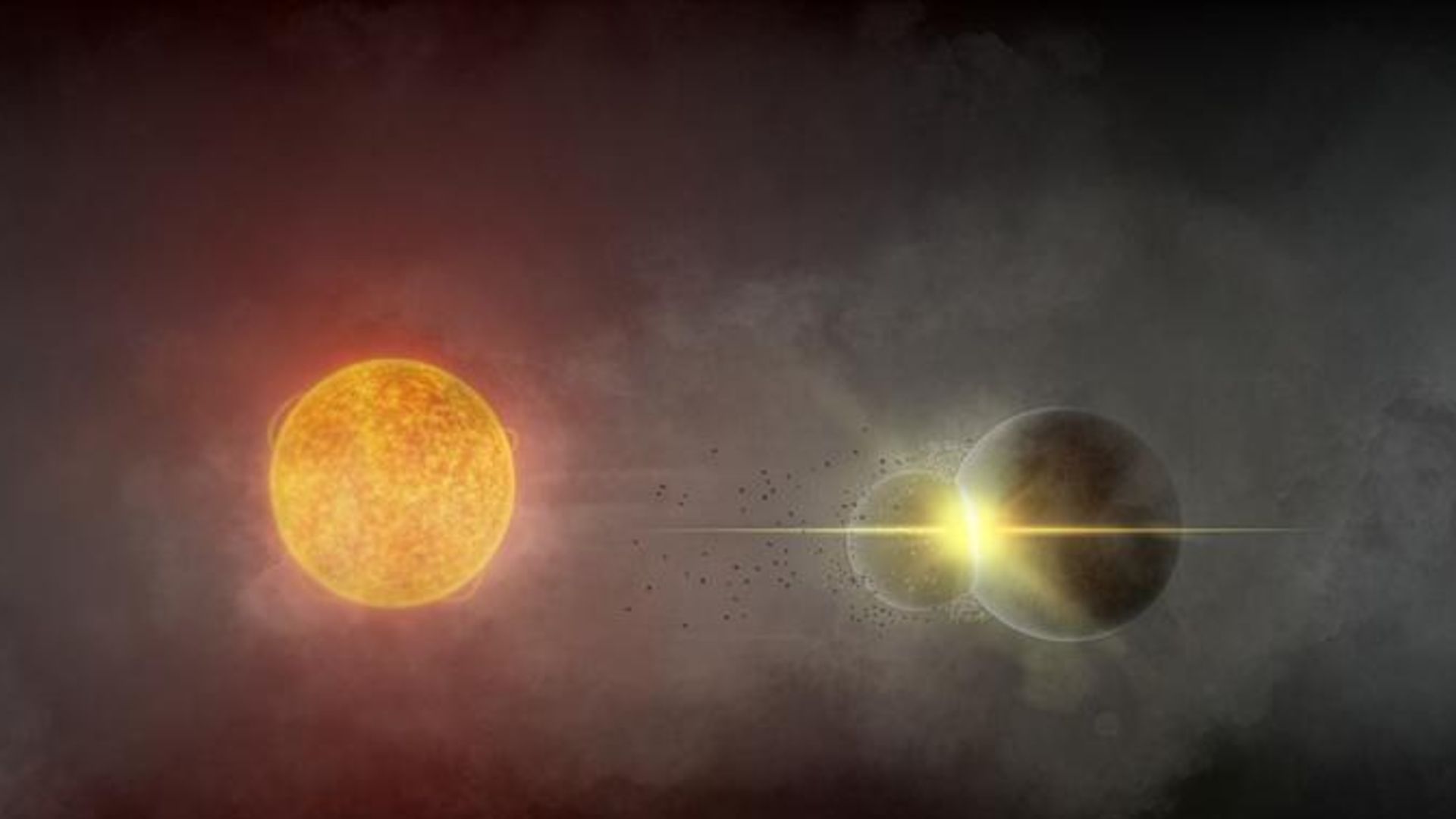
Astronomers think they’ve glimpsed one of the rarest sights in space: two planets smashing into each other around a distant star.

The collision appears to have unfolded roughly 11,000 light-years from Earth, around a sunlike star called Gaia20ehk, near the constellation Puppis (the “poop deck”). The researchers say the crash may echo the giant impact thought to have formed Earth and the moon billions of years ago, giving scientists a rare window into how celestial bodies take shape. The findings were published March 11 in The Astrophysical Journal Letters.

“It’s incredible that various telescopes caught this impact in real time,” lead study author Anastasios Tzanidakis, a doctoral candidate in astronomy at the University of Washington, said in a statement. “There are only a few other planetary collisions of any kind on record, and none that bear so many similarities to the impact that created the Earth and moon.”

Article continues below


You may like

A star that suddenly “went completely bonkers”

Planetary collisions are thought to be common in young star systems, but they are hard to catch. The planets must have orbits that take them directly in front of their home star, so that their debris blocks part of the star’s light, which telescopes can detect and measure in both visible and infrared light.

Tzanidakis spotted the first clue while combing through telescope data, including observations made by NASA’s SPHEREx mission. In 2016, Gaia20ehk looked like an ordinary, stable star. But about five years later, its light dipped suddenly three times and things quickly turned chaotic.

“Right around 2021, it went completely bonkers,” Tzanidakis said. “I can’t emphasize enough that stars like our sun don’t do that. So when we saw this one, we were like ‘Hello, what’s going on here?'”

Gaia20ehk’s particular changes ‪—‬ short drops in brightness and then chaos ‪—‬ had never been observed before, creating a conundrum for the astronomers.

Get the world’s most fascinating discoveries delivered straight to your inbox.

The data showing how Gaia20ehk’s light “went completely bonkers.” The top graph shows brightness measurements (green and yellow dots) of the star’s brightness in the visible light spectrum. Three small dips in brightness are apparent, followed by a more chaotic overall decline. The bottom graph shows measurements (pink, black and blue dots) of the star’s brightness in the infrared spectrum. The measurements show a sharp increase in infrared as the star’s visible brightness declines. (Image credit: Tzanidakis et al./The Astrophysical Journal Letters)

The first clue to what might be happening came from visible-light data, which showed that something was repeatedly passing in front of the star and blocking part of its light. But visible light alone could not show whether the culprit was just floating dust, a stellar outburst or something far more violent, such as a planet being torn apart by the gravity of a supermassive black hole.

To take a closer look, the team analyzed Gaia20ehk’s emission in the infrared spectrum. As the star’s visible light dipped and grew messy, its infrared signal surged, showing that while the system got dimmer, it was also getting hotter.

That “could mean that the material blocking the star is hot — so hot that it’s glowing in the infrared,” Tzanidakis said.


What to read next

That finding suggested to the team that a collision between two planets, while rare to see, was most likely, as two planetary bodies could throw out hot dust and rock into an orbit that would align with their findings.

The researchers think the planets may not have collided in a single instant. The three early dips of Gaia20ehk could mark grazing encounters as the two bodies spiraled closer together.

“At first, they had a series of grazing impacts, which wouldn’t produce a lot of infrared energy,” Tzanidakis said. “Then, they had their big catastrophic collision, and the infrared really ramped up.”

“Andy’s unique work leverages decades of data to find things that are happening slowly — astronomy stories that play out over the course of a decade,” senior study author James Davenport, an assistant research professor of astronomy at the University of Washington, said in the statement. “Not many researchers are looking for phenomena in this way, which means that all kinds of discoveries are potentially up for grabs.”

An image of a starry night sky, with blue glowing stars and red gas against a dark background. An orange boxout on the right shows a zoomed in area where the Gaia20ehk star system is.

A view of Gaia20ehk near the constellation Puppis. (Image credit: NASA/NSF NOIRLab)

The team hopes the powerful Simonyi Survey Telescope at the Vera C. Rubin Observatory could be used to discover other planetary collisions that may be difficult to spot. Davenport estimates that, using Rubin, astronomers could discover 100 new impacts over the next decade. Finding other planetary collisions could aid the search for possible habitable worlds that, like Earth, have a moon that helps shield them from asteroids, influences their tides and has other factors that make the world more welcoming.

In addition to being rare, the discovery could provide insight into the type of crash that made our moon. Astronomers said the debris cloud around Gaia20ehk sits at about one astronomical unit from its star — roughly the same distance as Earth orbits the sun — and that is one reason the event resembles the giant impact that struck Earth around 4.5 billion years ago.

If that comparison holds, the system could help researchers further test the theory that a planetary collision created our moon.

“How rare is the event that created the Earth and moon? That question is fundamental to astrobiology,” Davenport said. “Right now, we don’t know how common these dynamics are. But if we catch more of these collisions, we’ll start to figure it out.”

Tzanidakis, A., & Davenport, J. R. A. (2026). GaIa-GIC-1: an evolving Catastrophic planetesimal collision candidate. The Astrophysical Journal Letters, 1000(1), L5. https://doi.org/10.3847/2041-8213/ae3ddc


Moon quiz: What do you know about our nearest celestial neighbor?

Share. Facebook Twitter LinkedIn Telegram WhatsApp Email

Keep Reading

‘If astrological compatibility exists, its effects should be observable’: TL;DR — it’s not

‘If astrological compatibility exists, its effects should be observable’: TL;DR — it’s not

May’s Flower ‘micromoon’ will look extra small tonight, with a rare Blue Moon following

May’s Flower ‘micromoon’ will look extra small tonight, with a rare Blue Moon following

Poop-encrusted chamber pots from the Roman Empire reveal oldest known human cases of Crypto parasite

Poop-encrusted chamber pots from the Roman Empire reveal oldest known human cases of Crypto parasite

Weapons of the world quiz: Can you identify these historical objects of war?

Weapons of the world quiz: Can you identify these historical objects of war?

ZWO Seestar S30 Pro smart telescope review

ZWO Seestar S30 Pro smart telescope review

‘The detectors never stopped beeping!’ Nearly 3,000 coins discovered in field are Norway’s largest Viking hoard on record

‘The detectors never stopped beeping!’ Nearly 3,000 coins discovered in field are Norway’s largest Viking hoard on record

Doctors partially delivered a baby at 25 weeks to perform a lifesaving surgery and then returned him to the womb

Doctors partially delivered a baby at 25 weeks to perform a lifesaving surgery and then returned him to the womb

Google AI breakthrough means chatbots use six times less memory during conversations without compromising performance

Google AI breakthrough means chatbots use six times less memory during conversations without compromising performance

Used SpaceX rocket stage could hit the moon’s Einstein crater this summer, report finds

Used SpaceX rocket stage could hit the moon’s Einstein crater this summer, report finds

Add A Comment
Leave A Reply Cancel Reply

Editors Picks

Caitlin Clark’s home celebration took scary turn on flagrant foul

Caitlin Clark’s home celebration took scary turn on flagrant foul

May 1, 2026
Exclusive | Chirayu Rana — former JPMorgan banker at center of ‘completely fabricated’ ‘sex slave’ allegations against Lorna Hajdini — left new job 3 weeks ago

Exclusive | Chirayu Rana — former JPMorgan banker at center of ‘completely fabricated’ ‘sex slave’ allegations against Lorna Hajdini — left new job 3 weeks ago

May 1, 2026
Iran hands over latest proposal to end war with US

Iran hands over latest proposal to end war with US

May 1, 2026
Minnesota Republican lawmaker Kristin Robbins drops out of governor’s race

Minnesota Republican lawmaker Kristin Robbins drops out of governor’s race

May 1, 2026

Subscribe to News

Get the latest USA news and updates directly to your inbox.

Latest News
Taylor Frankie Paul’s Attorney Addresses Custody Hearing With Dakota Mortensen: ‘She Is Not Perfect’

Taylor Frankie Paul’s Attorney Addresses Custody Hearing With Dakota Mortensen: ‘She Is Not Perfect’

May 1, 2026
Three-point shooting will decide which side of history the Lakers end up on

Three-point shooting will decide which side of history the Lakers end up on

May 1, 2026
Gold IRA rules and taxes: What to know before you sign

Gold IRA rules and taxes: What to know before you sign

May 1, 2026
Facebook X (Twitter) Pinterest WhatsApp TikTok Instagram
© 2026 USA Times. All Rights Reserved.
  • Privacy Policy
  • Terms
  • Advertise
  • Contact

Type above and press Enter to search. Press Esc to cancel.