
Watch On
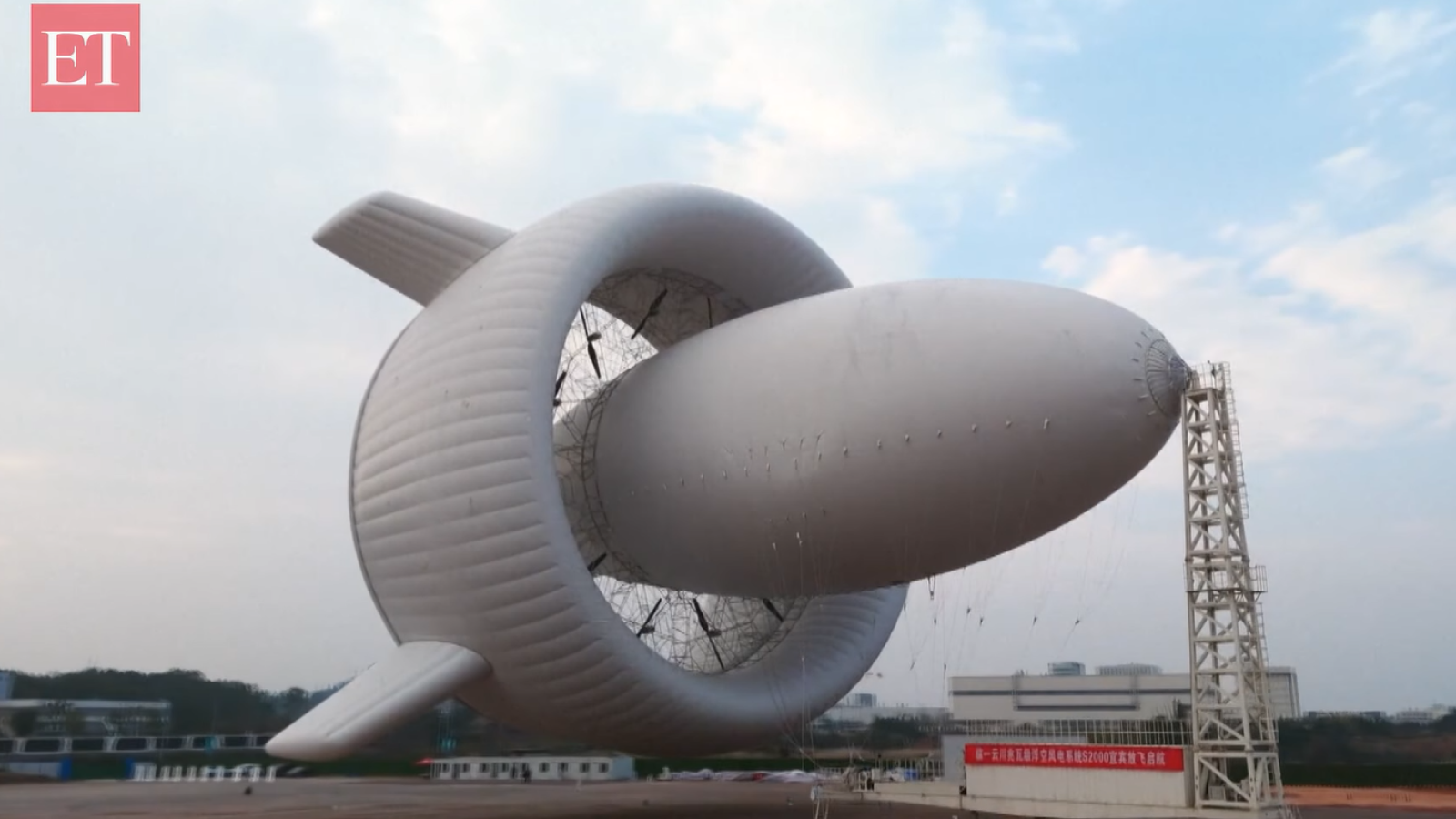
A Chinese energy firm has successfully tested an experimental blimp-like wind turbine capable of generating energy in the skies above cities and inland communities.
The craft ascends thousands of feet into the air to harness the stable wind speeds at higher altitudes, which spin the turbines and generate electricity. This is then sent down the tethering cable to the ground below, where it can enter the grid.
In its test flight, the manufacturers flew the S2000 at an altitude of 6,560 feet (2,000 meters) above Sichuan Province, generating 385 kilowatt-hours of electricity.
This is enough to power the average U.S. household for approximately 13.3 days, per usage figures provided by the U.S. Energy Information Administration.
In total, the S2000 clocks in at 197 feet (60 m) long, 131 feet (40 m) high and 131 feet (40 m) wide, as reported by Global Times. The system is rated at 3 megawatts total power capacity.
The new technology has a couple of potential uses, the developers suggest. “One is for off-grid settings like border outposts, where it can serve as a relatively stable conventional energy source,” explained Weng Hanke, CTO at Linyi Yunchuan Energy Technology, as reported by Tide News — an affiliate of the state-owned Zhejiang Daily Press Group — via Global Times.
“The other is to complement traditional ground-based wind power systems, creating a three-dimensional approach to energy supply.”
If realized at scale, the approach could have transformational potential for countries with constrained space for onshore wind generation, such as many in mainland Europe, as well as those without the shallow seabeds necessary for offshore wind power generation, such as Japan.
However, the reliability of the tethered cable for delivering stable power to the grid will require further testing.
In all but the most remote rural communities, the 1.25-mile (2,000 m) cable could present a dangerous obstacle to aircraft. In the U.K., the Civil Aviation Authority requires those wishing to fly tethered balloons above 200 feet (60 m) to apply for special permission to avoid risk to aircraft sharing airspace with the balloon.
Beyond its safety concerns, the S2000 will also need to undergo rigorous testing to ensure its viability for reliable commercial operations. Standard wind turbines require regular maintenance and the craft could prove difficult and more costly to service as it will have to return to the ground for every repair.
Wind power density
Wind turbines can generate more power where the wind power density — the measure of wind energy that can be harnessed at a given altitude — is higher. Offshore wind turbines, for example, can capture the higher, more consistent wind speeds over open water.
These offshore turbines can also be significantly larger than their onshore counterparts, with the hub of Chinese manufacturer Dongfang Electric’s DEW-26 MW-310 offshore turbine standing at 606.9 feet (185 m). Floating wind turbines can be similarly gigantic, with the tower for the recently-revealed, record breaking floating wind turbine from China Huaneng Group reaching 489 feet (152 m).
For example, the average offshore wind speed deemed suitable for wind farms at 295 feet (90 m) elevation within U.S. waters is 7 meters per second, per the Marine Cadastre National Viewer, a web-based data viewer produced by the Bureau of Ocean Energy Management and the National Oceanic and Atmospheric Administration (NOAA) Office for Coastal Management.
It’s hard to state the exact wind speed at various altitudes, as this varies by location and weather.
The aerospace group Omnidea estimates that at altitudes between 328 and 8,200 feet (100 and 2,500 m), wind power density increases by approximately a factor of six, with an average wind speed of 33.5 mph (15 m/s) at 8,200 feet
This highlights the potential efficiencies to be unlocked with greater exploitation of higher-altitude wind speeds with tethered, flying wind turbines such as the S2000.