





Follow us
Add us as a preferred source on Google
Subscribe to our newsletter
Archaeologists have found what may be the world’s oldest poisoned weapons at a 125,000-year-old site on an ancient lakeshore in Saudi Arabia. The stone tools, which were likely used to hunt large animals, had traces of residue from a poisonous tree historically used for its toxins.
“At 125,000 years old, these would be substantially older than the poisoned arrowheads recently identified in South Africa, which date to around 60,000 years ago,” study co-author Chris Clarkson, an archaeologist at the Max Planck Institute of Geoanthropology in Germany and Griffith University in Australia, told Live Science in an email. “But we haven’t demonstrated exactly how the poison was prepared or whether it was effective. So I’d describe these as potentially the oldest evidence for poisoned hunting weapons, rather than an unequivocally established first.”
In the new study, published Thursday (Nov. 12) in the journal Science, researchers investigated a 125,000-year-old site in southern Saudi Arabia known as ‘Uruq Aljelibah, which means “sand dunes of a watering hole,” study co-author Frans van Buchem, a geologist at the King Abdullah University of Science and Technology in Saudi Arabia, told Live Science.
Latest Videos FromLive Science
Today, the area is “hot, extremely dry, with extensive sand dunes,” Clarkson said, located as it is within the Empty Quarter — one of the hottest, driest deserts on Earth. But the scientists found the site was once home to a freshwater lake measuring about 130 square miles (340 square kilometers) and up to 95 feet (29 meters) deep. Fossils there suggest it once supported a rich diversity of flora and fauna, including hippopotamuses, buffalo, ostriches, camels, gazelles, oryx, palms, reeds, trees and shrubs, which early modern humans likely exploited for food and other resources.
“The idea of hippopotamuses and enormous buffalo living around a lake in what is now the Empty Quarter really brings home just how dramatically these landscapes, and global climates, have changed,” Clarkson said.
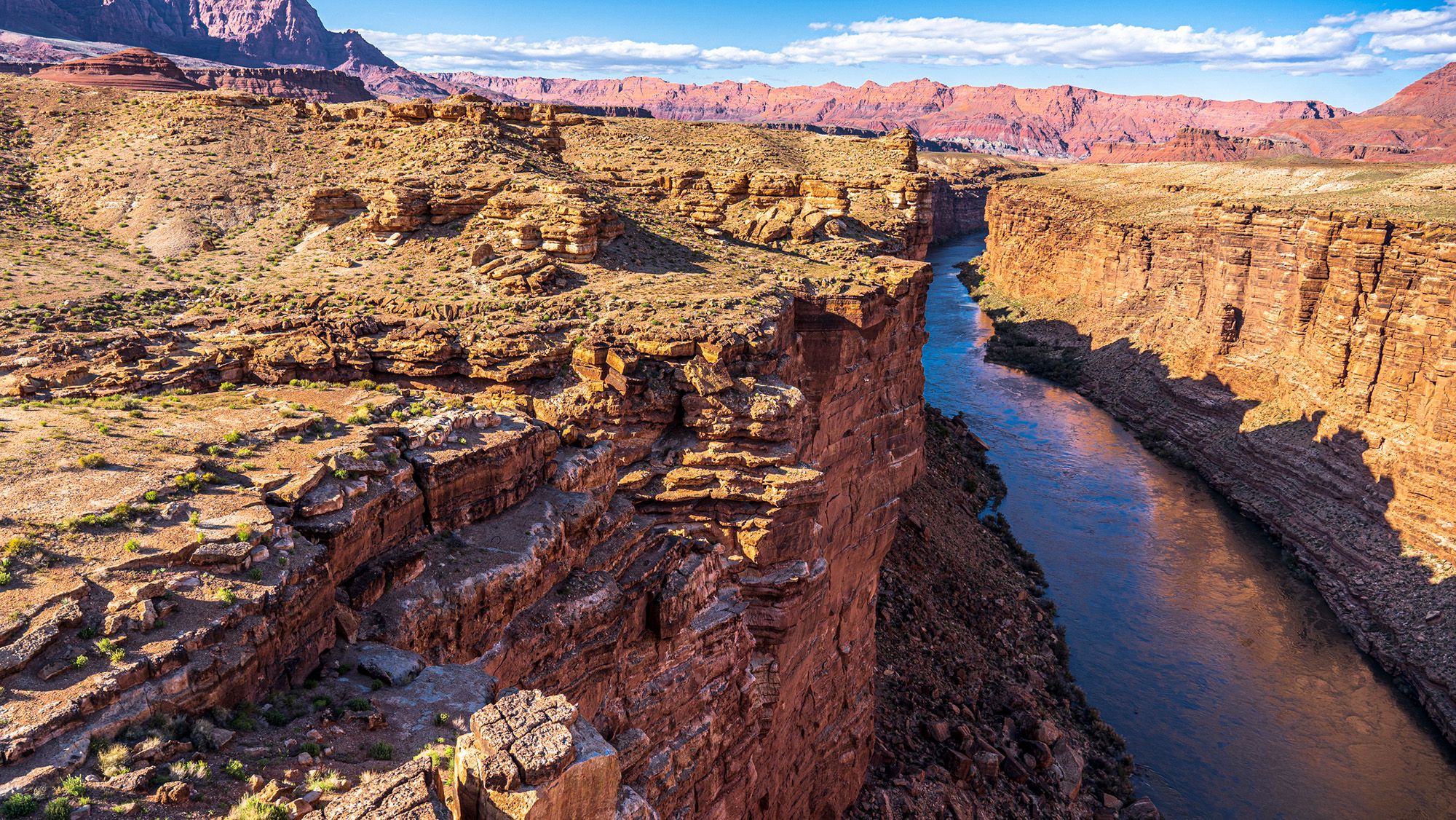
Saudi Arabia is a desert today, but it used to be a lush landscape.
(Image credit: Christopher Clarkson / Griffith University)
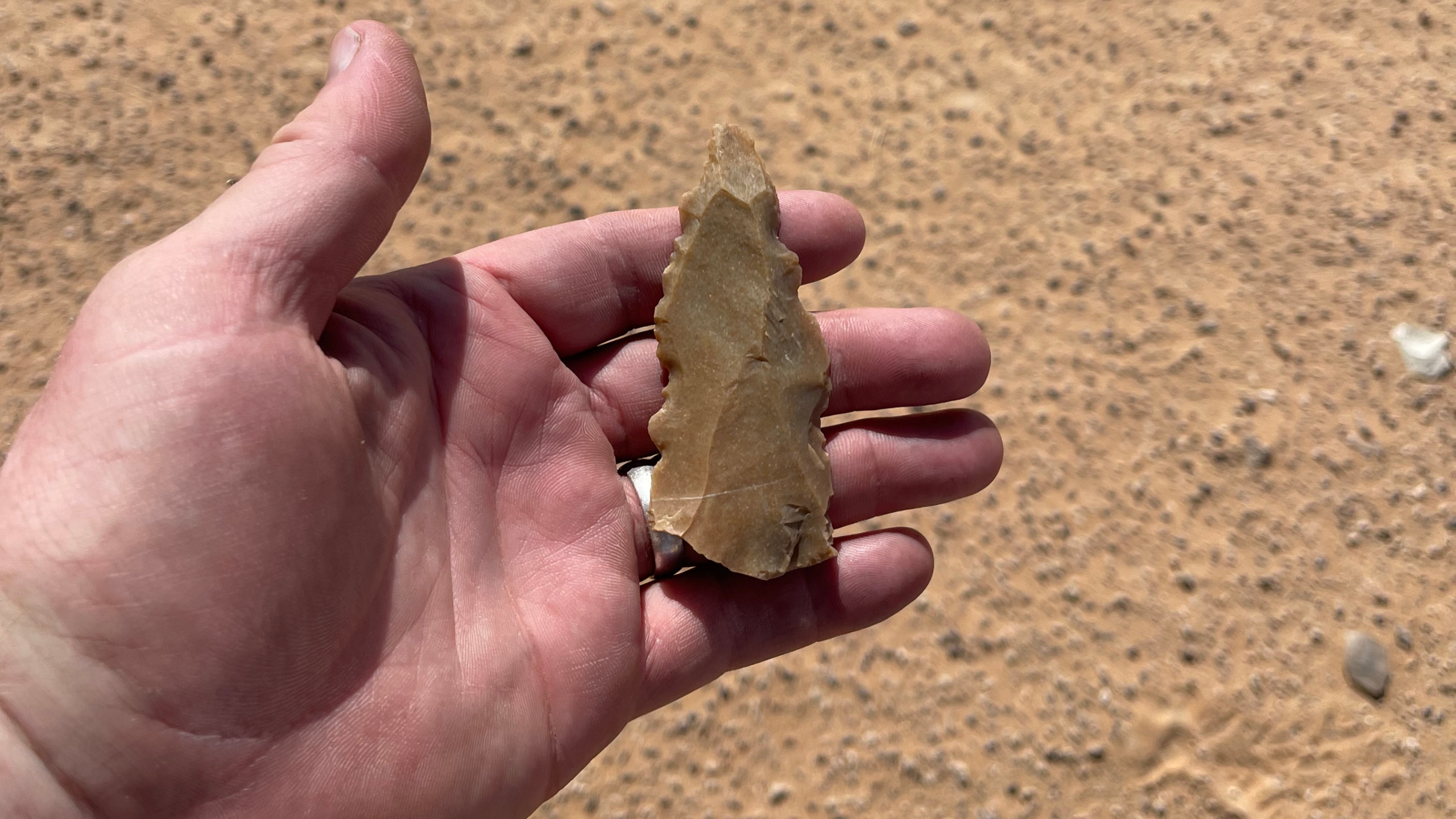
The archaeologists discovered more than 5,500 stone artifacts at the site, along with extraordinarily preserved traces of plant materials, such as fibers, resins and wood. Several of these artifacts were stone points that showed impact damage consistent with hunting large animals, and a microscopic analysis revealed traces of animal tissue near the point tips. The distribution of the stone tools closely matched clusters of animal bones, suggesting that the lakeshore was a focal point for hunting and processing game, according to the study.
“At most Paleolithic sites, we’re lucky if we get the stone tools and perhaps a few animal bones,” Clarkson said. “Here we can actually begin to reconstruct what those tools were doing and what other materials people were combining with them.”
Get the world’s most fascinating discoveries delivered straight to your inbox.
The researchers found that people may have hunted animals with poison-tipped tools. Several stone points had chemical residues linked with the arrow poison tree (Acokanthera schimperi), which is known historically for its toxins and is native to eastern and central Africa and southern Arabia. African hunters have coated spear tips and arrowheads with extracts from this plant to paralyze or kill game.
It remains unclear how hunters who poisoned their targets might have avoided poisoning themselves upon eating the game.
“The effects of a poison depend on the substance, the dose and how it enters the body,” Clarkson said. “A poison introduced directly into a wound doesn’t necessarily behave in the same way when swallowed.” Hunters throughout history “are known to sometimes remove the meat around the wound before eating the rest of the animal,” he added.
These findings emphasize how researchers have often underestimated the technological complexity of early human populations, because so much of what they made was organic and has simply disappeared,” Clarkson said. “These weren’t just people knocking stone flakes off cores,” Clarkson noted. “They were combining stone with wood, plant fibers, resins and potentially toxic substances to make complex tools and weapons.”
To have so much evidence for how people were making and using tools in a site like this “is remarkable,” Eleanor Scerri, an archaeologist at the Max Planck Institute of Geoanthropology in Germany who did not take part in this research, told Live Science in an email. “This goes from both the micro-scale, in finding traces of how people hafted spear tips, for instance, up to the bigger scale of the whole site and the very convincing spatial relationship between hunting-related tools and the bones of animals such as hippos.”
Sites in Arabia that possess both stone tools and animal bones are rare, Jeffrey Rose, a Paleolithic archaeologist at the University of Algarve in Portugal who did not participate in this study, told Live Science in an email. “This one has thousands of artifacts on an old lakeshore alongside hippo, buffalo and ostrich, and some of the flakes fit back together, so the tools were made on the spot,” he said. “It’s valuable new data.”
Out of Africa
The Arabian Peninsula sits between Africa and the rest of Asia and was a major corridor for humans as they dispersed across the world. Recurring spans of increased rainfall could have made its otherwise hostile landscapes more habitable in the past. However, the hot desert that now covers much of Arabia has made it difficult for scientists to excavate many details about this vital bridge during this critical point in human history.
The researchers did not unearth any human remains. Still, they suspect the site most likely belonged to modern humans (our species, Homo sapiens), as opposed to a different human species.
“We know that H. sapiens had already expanded out of Africa and were present in Southwest Asia during this period,” Clarkson said. “The age of the site fits with those early movements.”
These findings add to growing evidence that wetter intervals in Arabia created migration corridors between Africa and Asia and supported productive habitats capable of sustaining repeated human occupation.
“What our site shows is that people weren’t necessarily just passing through these environments,” Clarkson said. “They were exploiting them in quite sophisticated ways, using a range of technologies and resources.”
But Rose cautioned that all of the stone artifacts found in this study were collected from the surface. “Not one was excavated from the layers that were dated,” he said. “The 125,000-year date belongs to the lake, not to the tools. For the tools, it is only a maximum age.” Future research at the site should look for stone artifacts sealed in lake beds. “That’s hard in Arabia, where wind has stripped most sites down to surface scatters, but it can be done,” Rose said.
Clarkson agrees that further work is needed. “I’d really like to keep going back to this site to find more fossils, both animals as well as hopefully human fossils,” Clarkson said. “I’d also really like to push the chemical and functional analyses further, particularly the evidence for toxic plant compounds. It would be fascinating to determine exactly which substances were being used, how they might have been prepared and whether they were deliberately applied to hunting weapons.”
Future research focusing on the ancient lake margins may reveal more information. “There must be other places where people were living and carrying out activities, and some may preserve better stratified archaeological deposits,” Clarkson said.
But the combination of discoveries at this site is amazing, the researchers said.
“I’ve spent much of my career studying stone tools, and one of the great frustrations is that we’re usually only looking at the small fraction of ancient technology that survives,” Clarkson said. “Here we have a chance to see much more of the complete technological system.”
Clarkson, C., Price, G.J., Kalifi, A., Losi, G., Matheson, C., Al-Jibreen, F., Alsharekh, A.M., Armitage, S.J., Blilou, I., Boivin, N., Breeze, P.S., Drake, N., Duval, M., Gradwell, S., Groucutt, H.W., Guagnin, M., Guzmán, J., Hapiot, L., Martínez-Pillado, V., … van Buchem, F. (2026). Poisoned hunting weapons, megafauna, and plant use at a 125,000-year-old Arabian paleolakeshore. Science. https://www.science.org/doi/10.1126/science.aef9342