

For the first time, astronomers have witnessed the birth of one of the universe’s most powerful magnets, or magnetars, at the heart of an unusually bright supernova, thanks to an effect first predicted by Albert Einstein.
According to the researchers, this exciting discovery is the first time general relativity has been needed to describe the mechanics of an exploding star.
Article continues below
For more than a decade, researchers have predicted that the formation of magnetars could help explain “superluminous supernovas,” which shine at least 10 times brighter than most other stellar explosions. In theory, these rare light shows could occur if a magnetar formed at the supernova’s center, because the stellar remnant’s supercharged magnetism could further accelerate the ejection of charged particles. But until now, no one could prove this.
However, in a new study published March 11 in the journal Nature, astronomers discovered evidence of this phenomenon happening within a superluminous supernova, dubbed SN 2024afav, which exploded into the night sky in December 2024.
By analyzing the light curve of SN 2024afav — which shone for more than 200 days and was witnessed by more than two dozen telescopes across the globe — the team found that, after reaching its peak brightness, the explosion did not gradually fade as other supernovas do. Instead, its brightness brightened and dimmed at least four times, which the researchers claim is proof of a magnetar’s involvement.
“This is definitive evidence for a magnetar forming as the result of a superluminous supernova core collapse,” study co-author Alexei Filippenko, an astronomer at the University of California (UC) Berkeley, said in a statement. It is also the first time we have ever seen a magnetar being born, which is “what’s really exciting,” he added.
In the past, astronomers have witnessed other phenomena that may have birthed a magnetar, such as the merger of two smaller neutron stars. However, this new study is the first direct evidence of a magnetar’s birth.
The researchers also estimated the physical characteristics of the newborn magnetar based on the data they analyzed. They think it likely spins every 4.2 milliseconds (238 times per second) and that its magnetic field is roughly 300 trillion times greater than Earth’s magnetic field, which shields our planet from potentially dangerous solar storms.
“Strobing cosmic lighthouse”
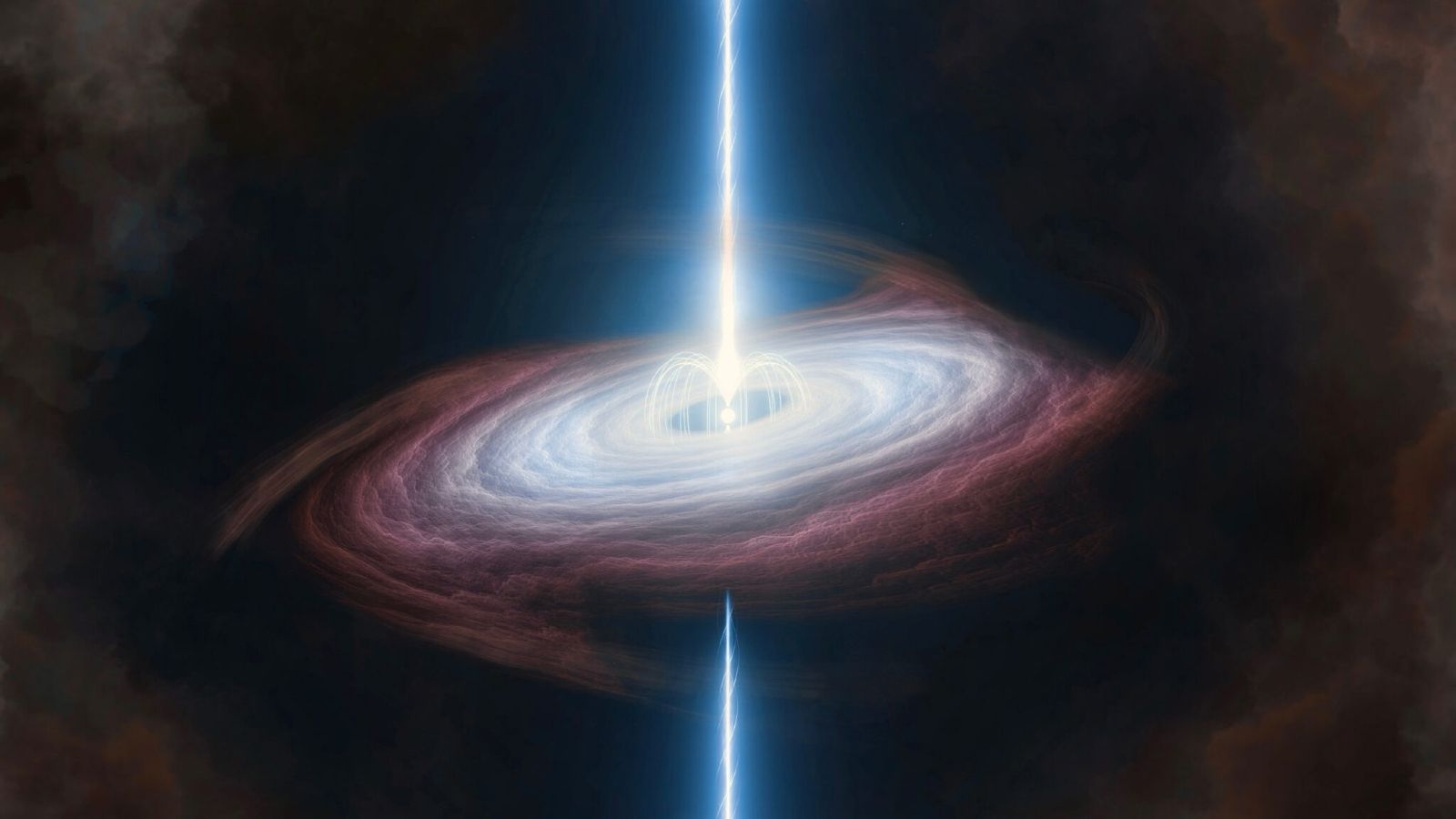
The wobbles within the light curve of SN 2024afav likely result from an accretion disk surrounding the newly born magnetar. This disk is made up of gas and dust from the exploding star that was pulled back toward the stellar remnant by its immense gravity. This is similar to the disks that are visible around black holes but would almost certainly be asymmetrical, meaning it would not align with the magnetar’s spin axis.
Einstein’s theory of general relativity tells us that such a disk would be subject to an effect known as Lense-Thirring precession, which would cause it to wobble relative to the magnetar’s spin axis, causing it to brighten and dim as it passed the line of sight between the stellar remnant and Earth.
“A wobbling disk could periodically block and reflect light from the magnetar, turning the whole system into a strobing cosmic lighthouse,” UC Berkeley representatives wrote in the statement.

The researchers detected four wobbles in the supernova’s light curve, with each new one being shorter and less intense than the last. This type of oscillation is similar to the cadence of several bird calls, which led the team to dub the wobbles “chirps” and is what would be expected from the Lense-Thirring effect.
“We tested several ideas, including purely Newtonian effects and precession driven by the magnetar’s magnetic fields, but only Lense-Thirring precession matched the timing perfectly,” study lead-author Joseph Farah, an incoming research fellow at UC Berkeley and a current doctoral candidate Las Cumbres Observatory in California, where SN 2024afav was first spotted, said in the statement. “It is [also] the first time general relativity has been needed to describe the mechanics of a supernova.”
For the researchers who first proposed this idea, the new findings are the “smoking gun” that they were right all along, UC Berkeley representatives wrote.
“For years, the magnetar idea has felt almost like a theorist’s magic trick — hiding a powerful engine behind layers of supernova debris,” Dan Kasen, an astrophysicist at UC Berkeley who was one of the first to suggest the Lense-Thirring hypothesis but was not involved in the new study, said in the statement. “The chirp in this supernova signal is like that engine pulling back the curtain and revealing that it’s really there.”
The new findings do not mean that all superluminous supernovas are tied to magnetars, because other researchers have already shown that these bright explosions can also be caused by “cocoons” of gas and dust surrounding exploding stars. But the study team is now planning to investigate which of these causes is most common throughout the cosmos.
The researchers expect to find dozens of similar “chirping” supernovas over the next few years, using the newly operational Vera C. Rubin Observatory in Chile, which they expect to be well suited to spotting these wobbly signals.