


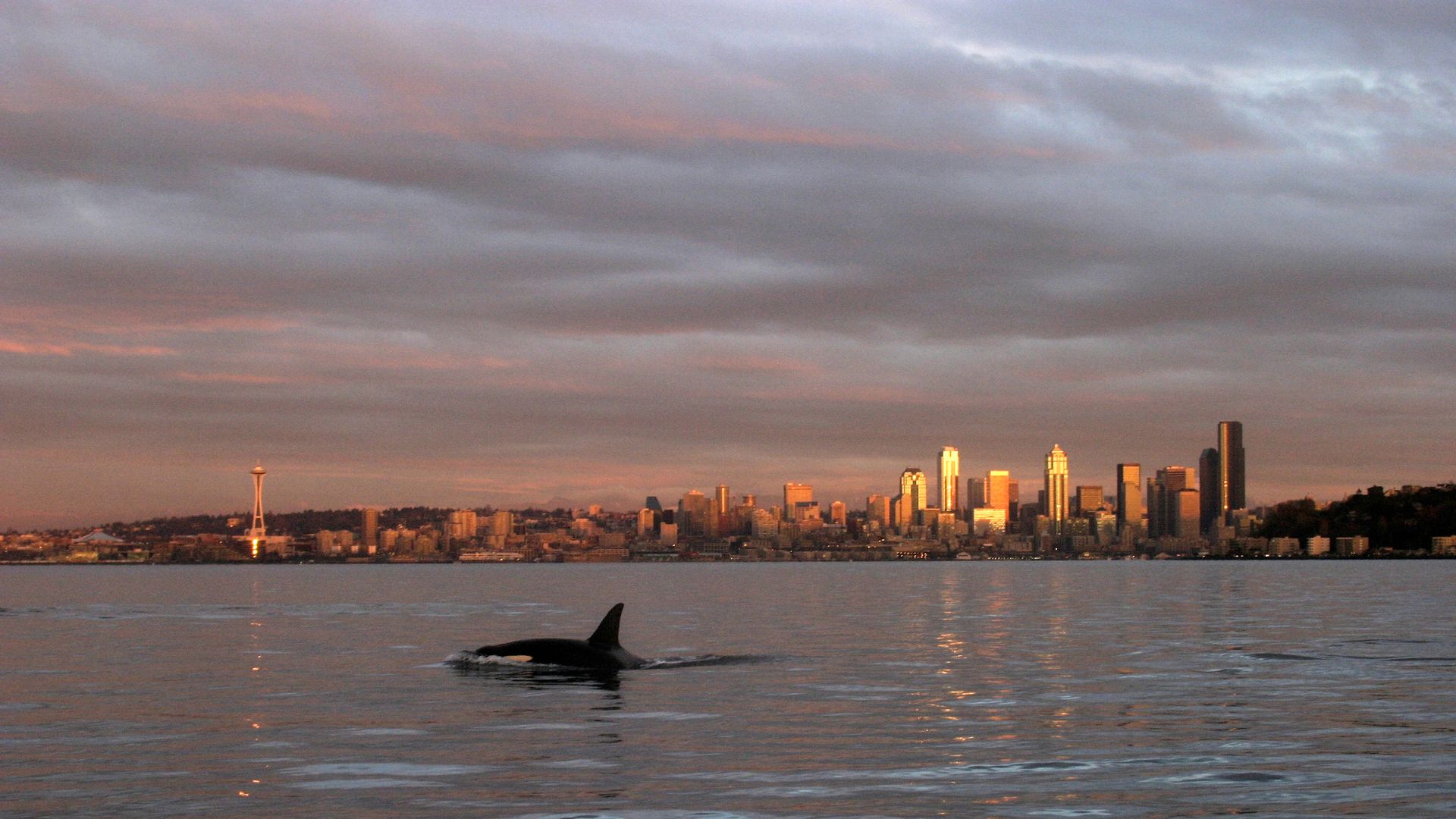


Scientists are scratching their heads over why three mammal-eating orcas turned up in Seattle waters in March, having apparently traveled 1,500 to 2,000 miles (2,400 to 3,200 kilometers) south from Alaska.
“It’s extremely rare to have previously undocumented killer whales show up in local waters, so it’s been very exciting to see them, and right now we have more questions than answers,” Monika Wieland Shields, the director of the Orca Behavioral Institute, a Seattle-based non-profit research organization, told Live Science in an email.
Killer whales (Orcinus orca) tend to travel within established ranges and return to the same areas and hunting grounds over years and even generations. If these orcas are in fact well outside their usual range, their presence could signal that something has shifted in prey availability, ocean conditions or the whales’ own behavior.
“We really have no idea what compels an individual whale to travel outside of their regular territory!” Wieland Shields said. “Thanks to decades of research and the ability to identify individual whales through photo ID, we know all of the individuals and families that regularly visit this region, including their approximate ages and family relationships. … Without this work, we wouldn’t even know that these new visitors are unusual!”
A shift in whale populations
Two types of orca subspecies live in the Salish Sea between Washington and Canada: endangered fish-eating Southern resident killer whales and mammal-eating Bigg’s killer whales.
These groups’ range have changed dramatically over the past few years as a result of shifts in food availability, Wieland Shields said.
“The Southern Residents no longer have abundant, reliable wild salmon to feed on here, so they’ve shifted their travel patterns elsewhere,” Wieland Shields said. “Bigg’s killer whales are here in ever-increasing numbers because the populations of their primary prey in the region — harbor seals, harbor porpoise[s] and Steller sea lions — are all booming.”
Experts think this could be why the new pod, identified as Bigg’s killer whales, is so far south.
“I am inclined to agree with a report that they may be following some food options,” Heather Hill, a psychologist focusing on marine mammal behavior at St. Mary’s University in San Antonio, told Live Science in an email. “They can be indicators of [the] health of an area — the whole food chain idea. Studying the different pods also helps us understand their social dynamics, such as how they share the same space with other transients or residents.”
For Seattle-based Wieland Shields, the pod’s arrival raises many more questions. “Until we have further acoustic and/or genetic evidence, we don’t know exactly which population they are from, and we have no idea how long they will stay.”
Think you know your orcas? Test your knowledge with our orca quiz!