

Quick Facts
What it is: Cat’s Eye Nebula (NGC 6543).
Where it is: 4,300 light-years away from Earth, in the constellation Draco.
When it was shared: Mar. 3, 2026.
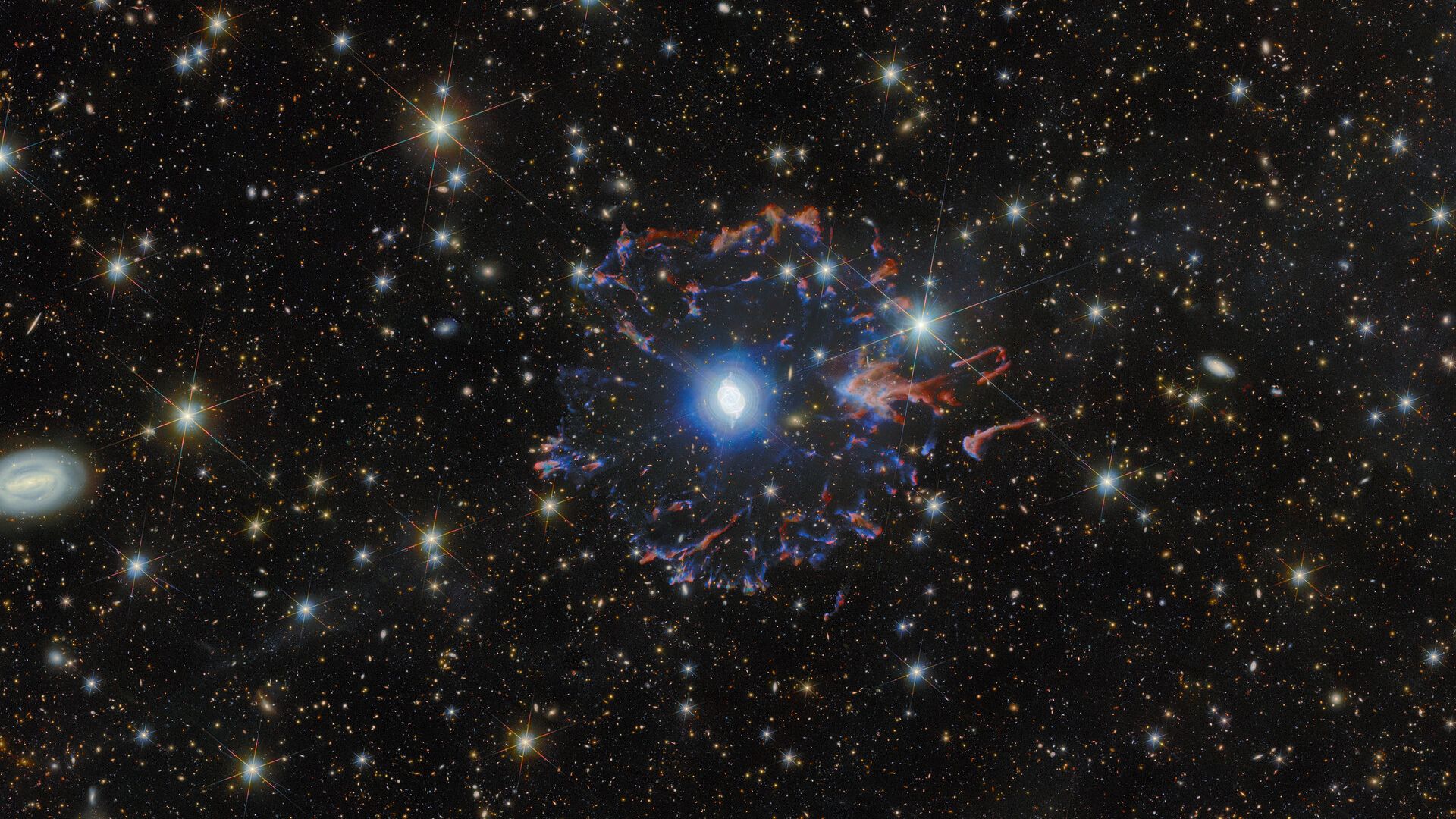
These stunning cosmic snaps show distorted glowing rings of blue, orange and red gas racing away from a dying star. Set against a sea of galaxies and stars, this image showcases the famous Cat’s Eye Nebula, otherwise known as NGC 6543.
As calm and beautiful as it appears, don’t be fooled. This scenic nebula was shaped by the messy interaction between the star’s intense winds, outer layers and powerful jets, thereby creating its intricate, eye-like structure.
Located roughly 4,300 light-years from Earth, the “Cat’s Eye” is a planetary nebula — an expanding cloud of glowing gas expelled by a star of low to medium mass that has reached the final stages of its life. Unlike more massive stars, which die in violent supernova explosions, the central star has gently shed its outer layers into space, creating beautiful and complex shells of discarded material.
Article continues below
These spectacular images were created using observations from the Hubble Space Telescope and the European Space Agency’s (ESA) Euclid space telescope.
Euclid’s wide-field view, captured in visible and near-infrared light, shows faint arcs and delicate filaments of gas surrounding the bright central region. These wispy structures appear to be flying off the scene, into space, and are thought to have been expelled during an earlier stage of the star’s death, before the outer layers were shed that formed the main nebula.
Hubble has captured the fine details of the bright central region of the nebula. This close-up view was taken using visible light and shows a dead yet bright star surrounded by white bubbles and blue loops of gas. Using its Advanced Camera for Surveys, Hubble has revealed even finer, intricate details at the heart of the nebula, including the complexity of gas bubbles and delicate filamentary structures embedded within those bubbles.
These finer details serve as a “fossil record” of the nebula, according to an ESA statement. Each gas bubble corresponds to an episode of mass loss of the dying star. In the image, these bubbles are followed by concentric circles or rings within a brown halo; each ring marks the boundary of the bubbles. Further, the data reveal jets of energetic and high-speed gas, shown in pink, that shoot out from the top and bottom of the nebula. There are also dense knots formed by shock interactions of high-speed jets and slowly-expanding ejected material.
While Hubble captures the unprecedented details of the dying star’s bright nest and its immediate surroundings, Euclid reveals the faint arcs and colorful gas filaments a little farther from the nebula, along with the wider cosmic landscape dotted with distant galaxies. Together, they present an almost cinematic view of the final act of a dying star.