




QUICK FACTS
What it is: Nebula PMR 1, also known as the “Exposed Cranium”
Where it is: 5,000 light-years away in the constellation Vela
When it was shared: Feb. 25, 2026.
The powerful James Webb Space Telescope (JWST) has revealed never-before-seen details of a cosmic “cranium” made of the glowing remains of a dying star.
This brainy object, named PMR 1, is a planetary nebula — an expanding shell of ionized gas and dust expelled by a star in the final stages of its evolution, when the nuclear fuel within its core is depleted. It was first spotted in 2014 by the Spitzer Space Telescope (a predecessor to JWST) but has been little studied until now.
The colorful cloud is said to resemble a brain encased within a transparent skull, which has led to it being dubbed the “Exposed Cranium” nebula.
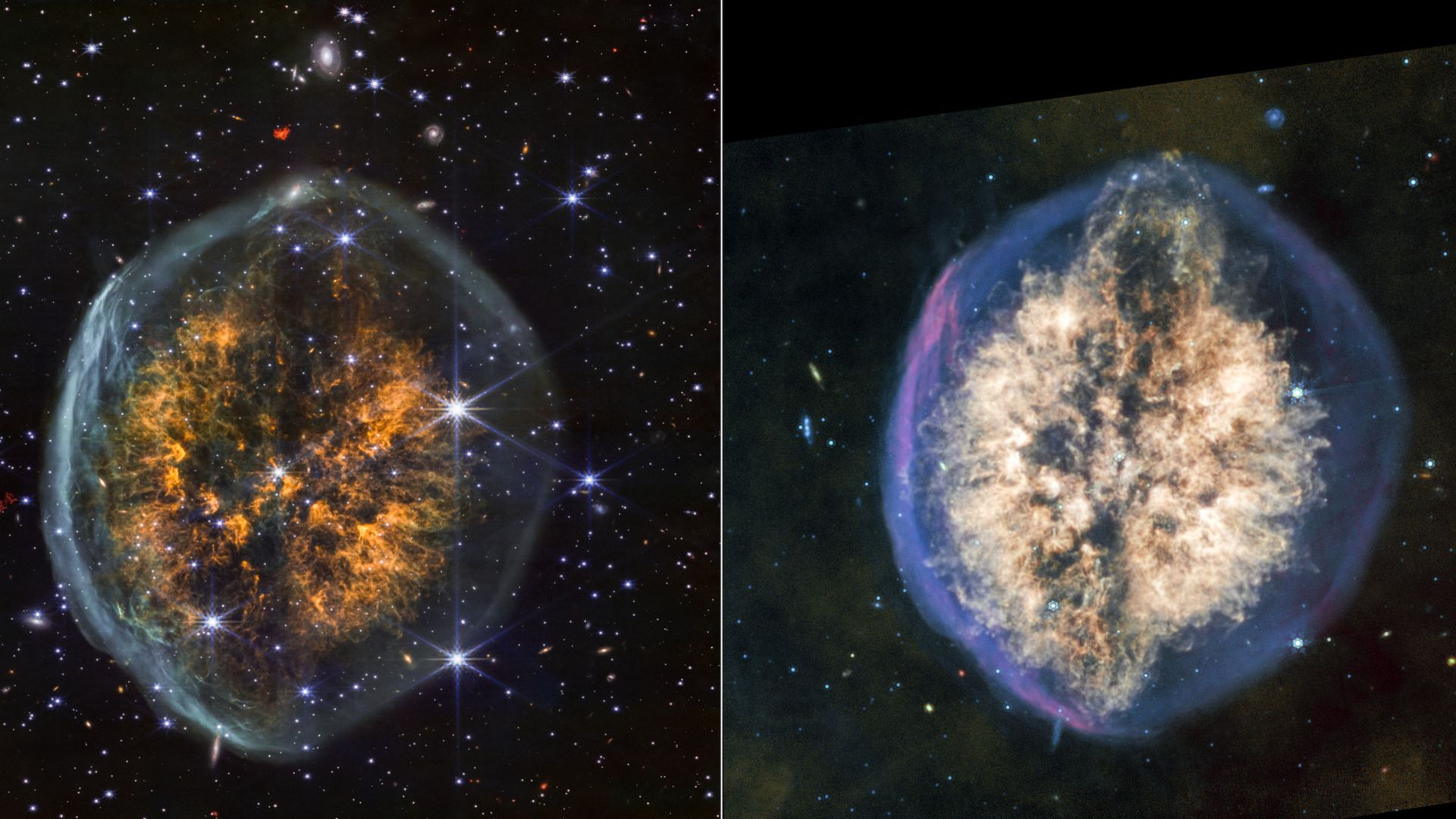
The new image comes in two parts, captured by different instruments: the Near-Infrared Camera (NIRCam) on the left and the Mid-Infrared Instrument (MIRI) on the right. By observing the object at different wavelengths, JWST can reveal intricate details that were previously invisible, according to NASA.
In the NIRCam image, the nebula’s outer bubble appears with a bright white edge, while the inner clouds glow orange. It highlights a distinctive dark lane that cuts vertically through the center, creating the illusion of two hemispheres, like a brain. Stars and distant background galaxies are also visible through the nebula’s outer shell in near-infrared light.
Things look different in the MIRI image, where mid-infrared light shows an outer bubble that appears bluish with a touch of purple. The glowing clouds within the nebula look thicker and more complex, while the central dark lane is less visible because it’s partially obscured by dust and gas.
That dark lane is a great example of why Webb’s ability to see the universe in multiple wavelengths of light is so valuable to astronomers. While the dark streak is much easier to see in the NIRCam image, it appears to be more closely connected to twin eruptions of gas at the top and bottom of the nebula as seen in the MIRI image. Together, the two images paint a more complete picture of exactly what is happening in this cosmic cranium.
The images also provide an insight into multiple stages of the star’s evolution, with an outer shell of hydrogen gas expelled earlier in the star’s life and inner clouds of a mixture of gases and dust expelled more recently.
What will eventually happen to the star at the center of PMR 1 depends on its mass: it will either explode as a supernova or continue to shed layers, leaving behind a dense, shriveled core known as a white dwarf star.