





QUICK FACTS
What it is: The Egg Nebula (CRL 2688), a planetary nebula
Where it is: 1,000 light-years away, in the constellation Cygnus
When it was shared: Feb. 10, 2026
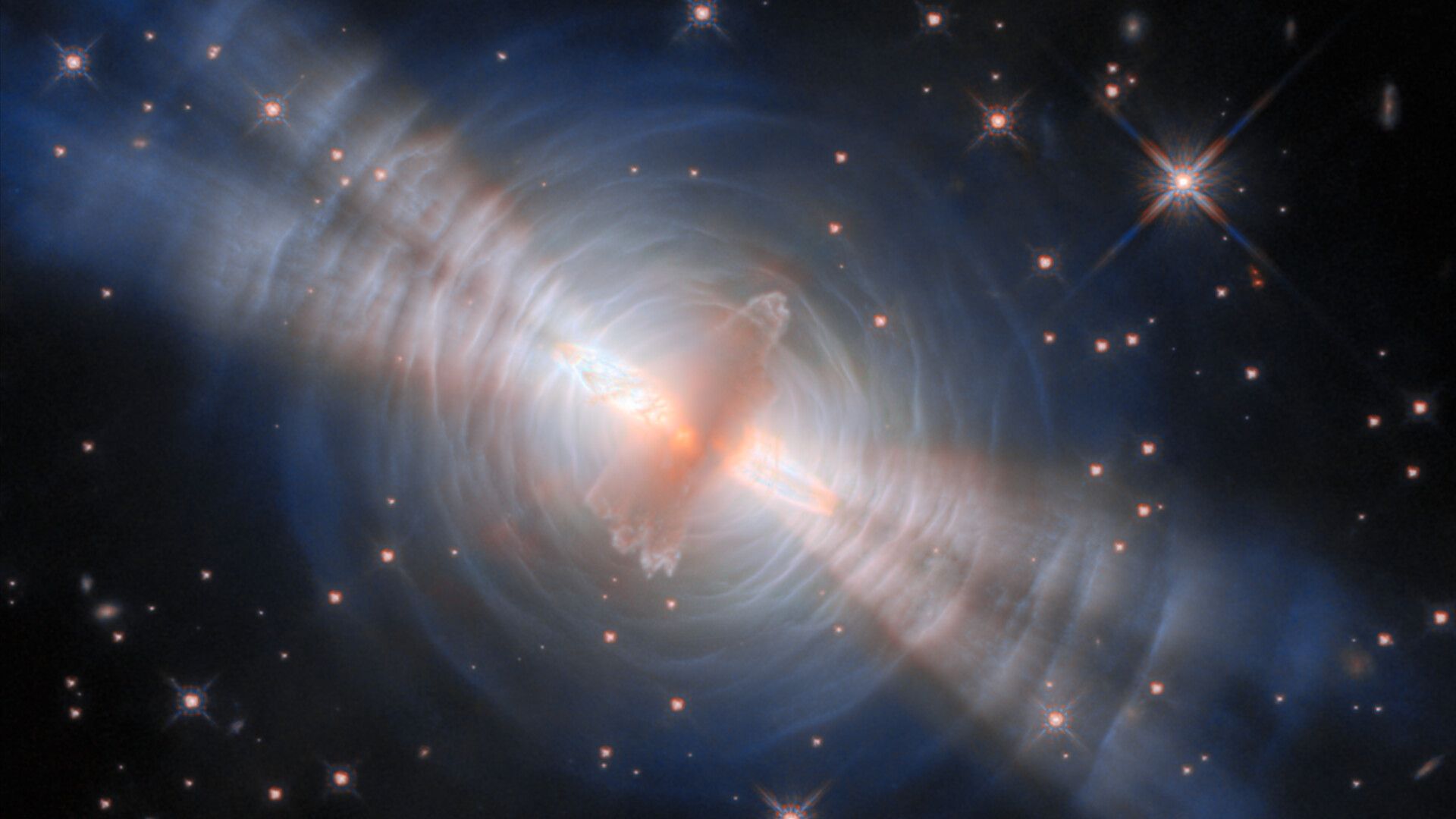
A searchlight shines through concentric circles of fresh stardust ejected by a dying star in this beautiful new image of the Egg Nebula. The dramatic scene, captured by the Hubble Space Telescope, also provides tantalizing evidence of exactly what happens to sunlike stars as they reach the end of their lives.
However, they are actually expanding shells of ionized gas and dust expelled by stars during the final stages of their evolution, leaving behind dense stellar remnants called white dwarfs at their centers.
The Egg Nebula is one of the only known planetary nebulas in a very early stage — a pre-planetary nebula. It gives scientists a detailed view of a fleeting transitional phase that lasts only a few thousand years, before the gas and dust are dispersed to form a fully developed planetary nebula.
There are many examples of those, including the Helix Nebula, the Stingray Nebula and the Butterfly Nebula. But the Egg Nebula is one of the only places where astronomers can see what happens as a star exhausts its hydrogen and helium fuel and begins to shed its outer layers into space. The short lifespan of pre-planetary nebulas means that very few exist at any given time in cosmic history, and they’re extremely dim.
Hubble has peered at the Egg Nebula before — in 1997, 2003 and 2012 — and it was the latter data, combined with new data, that created this new image. In this early stage of becoming a planetary nebula, the light in the Egg Nebula comes from its star, which expelled a dense disk of dust just a few hundred years ago.
Now blocked by dust, light from the star escapes through polar openings, forming twin beams. The concentric arcs and symmetry are evidence that the star regularly “burps” out mass, and they rule out the possibility of a chaotic supernova explosion.
Webb and Chandra’s deepest views
The James Webb telescope and Chandra X-ray Observatory captured a galaxy cluster in the making when the universe was only one billion years old.